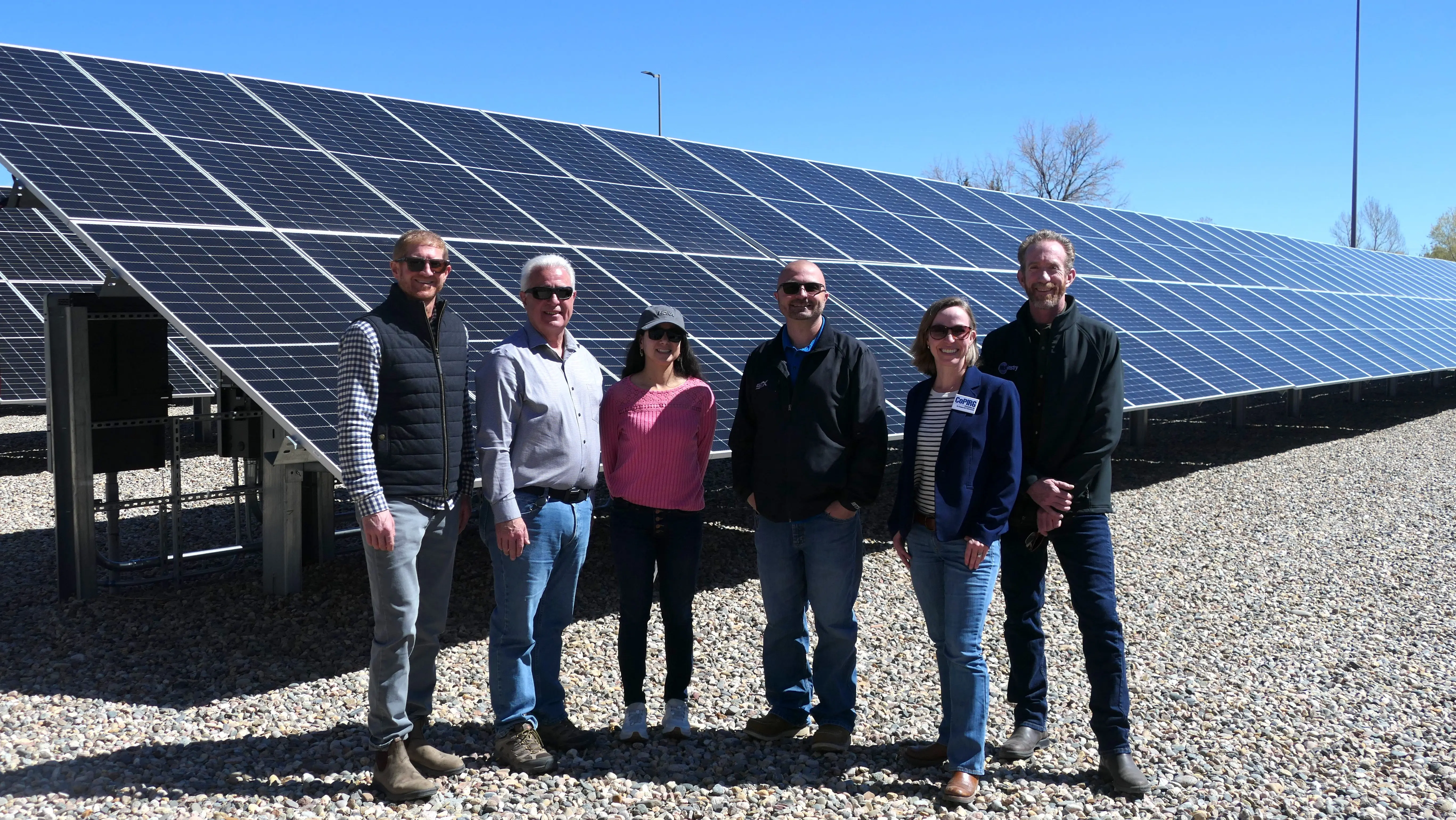
By Shannon Lukens for Steamboat Radio News/Birchwood Communications LLC.
A tour of solar projects in the Yampa Valley was held Tuesday. In Moffat County, it included the solar field at Yampa Valley Electric, the Craig Water Treatment Plant, Moffat County High School and the Moffat County Courthouse.
That’s where we joined Roy Tipton, the Project Specialist for the Moffat County Courthouse project.
“So as part of the courthouse project, we consolidated five different facilities under one roof. That gives us efficiency, brings everybody here, built a building to the current energy code. This field is part of that same plan to reduce costs overall and be more efficient with the county. So this field saves us about $30,000 a year, off of our utility bill to YVEA.”
The solar panel tour in the afternoon included the Hayden Center, Hayden Police Department and Yampa Valley Regional Airport. Town Manager Mathew Mendisco also says solar panels are at the Wastewater Treatment Plant in Hayden, which makes a difference throughout Hayden.
“Because it helps the community save on its energy bills as we see infrastructure and rates going up.”
Thirteen solar projects in Moffat and Routt counties have produced enough energy to power more than 1,300 average American homes for one year. The solar garden at YVEA have generated more than 22.5 million kilowatt hours of energy since 2023, enough to power more than 2,100 average American homes for a year.
More information is below.
Press Release from the CoPirg Foundation; April 7, 2026.
RELEASE: Tour highlights solar project benefits in Yampa Valley
Solar arrays in Moffat, Routt Counties show why other CO communities should pursue solar before federal tax credits expire
CRAIG, Colo. — Clean energy advocates, local government leaders and community members toured seven successful community- and commercial-scale solar installations in the Yampa Valley on Tuesday. The sites visited included Moffat County High School, Hayden Police Station and the Yampa Valley Regional Airport.
During the “Yampa Valley Solar Corridor Tour,” event leaders revealed that a total of 13 solar projects in Moffat and Routt counties have produced enough energy to power more than 1,300 average American homes for one year. According to energy company McKinstry, the projects also produced total utility bill savings to date of approximately $1.3 million and have reduced harmful air pollution, including 7,840 lbs of sulfur dioxide, 12,165 lbs of nitrogen oxides and 24,911,874 lbs of carbon dioxide.
In addition, energy company Ameresco shared that the Yampa Valley Electric Association Solar Garden has generated over 22.5 million kilowatt-hours of energy since its completion in late 2023, which is enough to power more than 2,100 average American homes for one year.
“These solar projects in the Yampa Valley are shining examples of how we can harness pollution-free energy right in our communities,” said Kirsten Schatz, clean air advocate with CoPIRG Foundation. “Other communities in Colorado interested in enjoying the benefits of solar should move quickly to qualify for federal tax credits before time runs out.”
Beginning in 2020, northwest Colorado communities including the City of Craig, City of Steamboat Springs, Moffat County, Yampa Valley Regional Airport, Town of Yampa, Town of Oak Creek, Moffat County School District and Town of Hayden launched a coordinated effort to reduce energy costs, improve reliability and advance the state’s goal of 100% renewable energy.
“This effort reflects Craig’s commitment to building a resilient and diversified energy future,” said Craig City Manager Peter Brixius. “We are taking advantage of solar today while laying the groundwork for expanded renewable energy, including battery storage and geothermal. As our community transitions from coal-based generation, these projects help reduce costs, improve reliability and position our utilities for long-term sustainability.”
These clean energy projects across Moffat and Routt Counties have been driven in part by the federal Investment Tax Credit, which provides a base credit of up to 30% of project costs and allows public entities and nonprofits to receive funding through direct payment. The 13 specific arrays built by McKinstry were funded in part by a Colorado Department of Local Affairs grant which brought simple paybacks for the projects down to 11 years.
As new deadlines for federal tax credits approach, similar efforts across Colorado could depend on whether communities are able to move quickly enough to qualify for available funding.
“The window for federal tax credits for commercial-scale solar installations is starting to close,” said Martin Beggs, renewable energy project director for McKinstry, which has helped to deliver clean energy projects in Colorado. “Communities that act quickly can still secure federal funding covering 30% or more of the total cost for their solar projects.”
###
About CoPIRG Foundation: Through research, public education and outreach, CoPIRG Foundation serves as a counterweight to the influence of powerful special interests that threaten our health, safety or well-being.
About McKinstry: McKinstry is a national leader in designing, constructing, operating and maintaining high-performing buildings. From new construction and ongoing operations to adaptive reuse and energy retrofits, the company provides a single point of accountability across the entire building lifecycle. McKinstry focuses on people and outcomes to ensure the built environment serves owners, operators and occupants alike. McKinstry is your trusted partner for the life of your building. To learn more, visit www.McKinstry.com.