(Graphics provided to Steamboat Radio.) This is a weekly update. Visit YampaValleyResources.org today to explore all the resources available for you and your household. Together, we are working to create a stronger, more resilient Yampa Valley where everyone has access to the resources they need to thrive.
Links to past Mental Health Minutes are below.
Understanding EMDR: A Powerful Path Toward Healing
One of the most common questions from people beginning their mental health journey is, “What exactly is EMDR, and how does it work?”
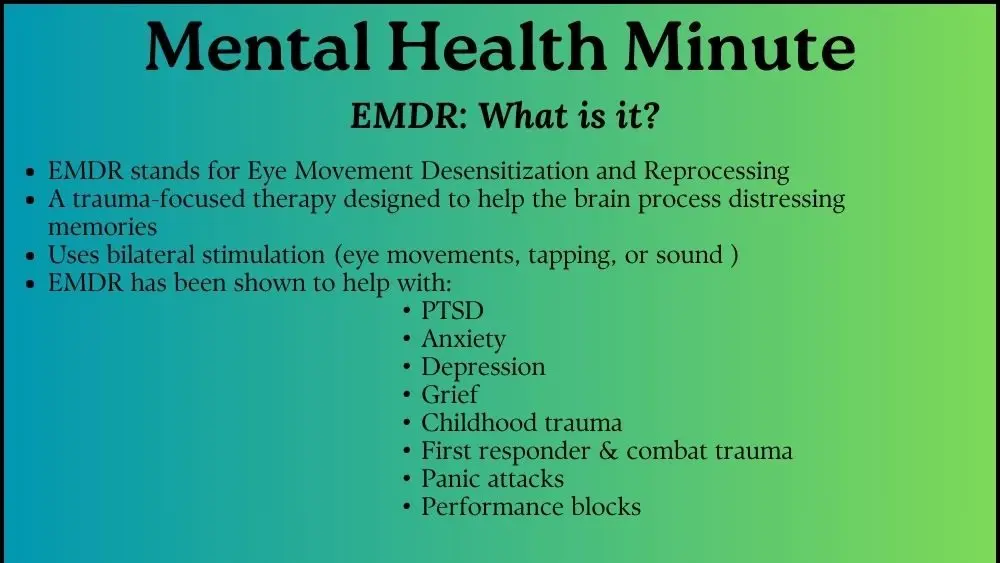
EMDR stands for Eye Movement Desensitization and Reprocessing, a trauma-focused psychotherapy developed by psychologist Dr. Francine Shapiro in the late 1980s. It was originally designed to help people process traumatic memories, particularly those associated with post-traumatic stress disorder (PTSD). Over time, research has shown that it can also be effective for anxiety, depression, grief, and other emotional struggles connected to unresolved experiences.
At its core, EMDR works by helping the brain reprocess memories that have become “stuck.” When a traumatic event occurs, the brain sometimes stores the memory in a fragmented and emotionally charged way. Instead of becoming something we remember and move past, the experience stays active in the nervous system. This is why certain sights, sounds, or situations can suddenly trigger intense emotional reactions.
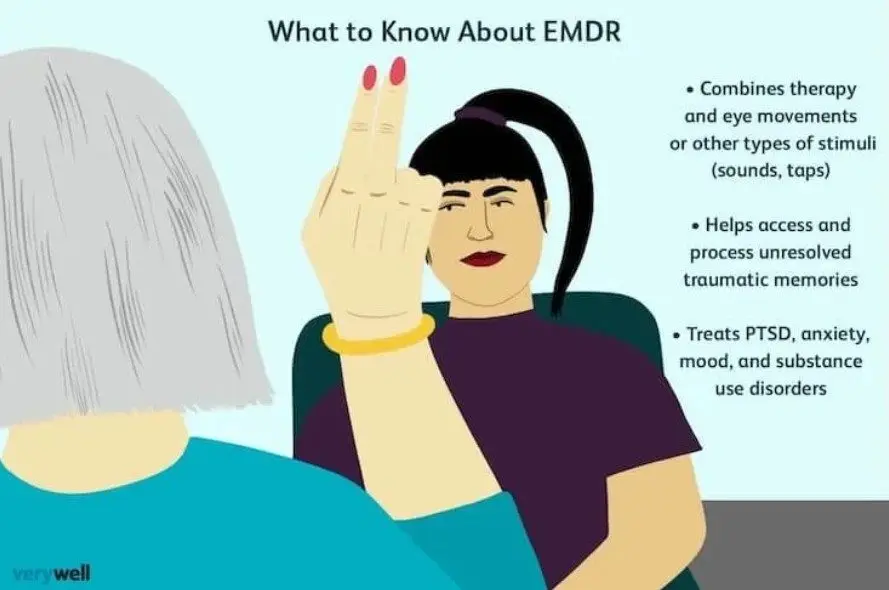
During EMDR therapy, the client briefly focuses on a troubling memory while engaging in bilateral stimulation—often guided eye movements, tapping, or alternating sounds. This process activates both sides of the brain and allows the memory to be reprocessed in a healthier way. Over time, the emotional charge around the memory decreases, negative beliefs begin to shift, and the nervous system can finally settle.
What makes EMDR particularly unique is that clients do not have to relive every detail of the trauma or spend long periods talking through the experience. Instead, the brain does much of the healing work internally.
Why EMDR Works
The effectiveness of EMDR is strongly supported by research. It is considered one of the most studied trauma treatments and is recommended in many clinical guidelines for PTSD treatment.
Studies have found that between 77% and 90% of individuals experience significant relief from PTSD symptoms after EMDR therapy, particularly when the trauma is tied to a specific event.
In some research, up to 90% of individuals with single-event trauma no longer met criteria for PTSD after just three sessions, while many combat veterans experienced a 78% reduction in symptoms after about twelve sessions.
What is also encouraging is that these improvements often last. Research shows that reductions in trauma symptoms and emotional distress can be maintained months after treatment ends.
How Many Sessions Does EMDR Take?
The number of sessions varies depending on the person and the complexity of their experiences.
For single-event trauma, some individuals experience major relief in three to six sessions. For more complex or long-term trauma, therapy may take longer, often averaging six to twelve sessions or more.
Healing is not a race, and the goal is always to move at a pace that feels safe and sustainable.
Long-Term Effects
One of the reasons EMDR is so powerful is that it does not simply teach coping strategies—it actually helps the brain reprocess and resolve traumatic memories. After successful treatment, many people notice that the memory itself remains, but it no longer carries the same emotional intensity. Distress decreases, negative beliefs shift, and the body’s stress response calms.
Clients often report feeling more grounded, more present, and more able to move forward with their lives.
EMDR and Integrative Healing
While EMDR is incredibly effective on its own, it also works well when combined with other therapeutic approaches. Healing rarely happens in just one dimension, and many people benefit from a multi-modal approach to mental health.
For example, EMDR can be paired with traditional talk therapy, which helps individuals build insight, develop emotional awareness, and strengthen coping skills. It can also be integrated with equine-assisted therapy, where the presence of horses helps regulate the nervous system and allows individuals to experience connection and trust in a non-verbal way.
In some cases, people may explore other emerging modalities such as ketamine-assisted therapy, microdosing protocols, mindfulness practices, somatic therapies, or experiential approaches. These modalities work on different levels of the brain and body, helping individuals access healing from multiple directions.
The most effective treatment plans often involve combining approaches that support both the mind and the nervous system.
A Final Thought
Trauma can leave people feeling stuck, overwhelmed, or disconnected from themselves. But healing is possible. The brain is remarkably capable of repairing itself when given the right tools and support.
EMDR is one of those tools.
Whether it is combined with talk therapy, experiential work, or other supportive modalities, the goal remains the same: helping people reclaim their sense of safety, resilience, and connection to life.
And perhaps most importantly, reminding people that they are not broken—they are human, and healing is possible.
Submitted by:
Valery Lozano LPCC, Warhorse Ranch
This is the continued Mental Health Minute, beginning July 7, 2025.
- March 15, 2026 — Mental Health Minute — Understanding Eye Movement Desensitization and Reprocessing
- March 10, 2026 — Mental Health Minute — Teens as a Catalyst for Change
- Feb. 23, 2026 — Mental Health Minute — Alcohol Consumption
- Feb. 16, 2026 — Mental Health Minute — How Volunteering Can Support Your Mental Health
- Feb. 11, 2026 — Mental Health Minute — Processing Grief
- Feb. 1, 2026 — Mental Health Minute — Free Local Sober Events
- Jan. 26, 2026 — Mental Health Minute — The Nervous System
- Jan. 18, 2026 — Mental Health Minute — A message from Yampa Valley High School
- Jan. 11, 2026 — Mental Health Minute – Prioritizing Mental Health Like Physical Health (Youth-Focused)
- Jan. 4, 2026 — Mental Health Minute — Healing through tears, laughter and love
- Dec. 28, 2025 — Mental Health Minute — The HOPE Initiative from The Health Partnership
- Dec. 14, 2025 — Mental Health Minute — Standing Together: Men’s Work and “Walking Each Other Home”
- Dec. 8, 2025 — Mental Health Minute — The Gut and Brain Connection
- Nov. 30, 2025 — Mental Health Minute — Your Voice Matters
- Nov. 24, 2025 — Mental Health Minute — Seasonal Affective Disorder
- Nov. 16, 2025 — Mental Health Minute — Time Change Blues
- Nov. 10, 2025 — Mental Health Minute – Navigating Changes in Midlife for Women
- Nov. 3, 2025 — Mental Health Minute — Stress Management in Teens
- Oct. 28, 2025 — Mental Health Minute — Day of the Dead
- Oct. 19, 2025 — Mental Health Minute — Sacred Moments: Finding the Sacred in the Ordinary
- Oct. 13, 2025 — Mental Health Minute — Talk Saves Lives: Empowering Our Community to Prevent Suicide
- Oct. 6, 2025 — Mental Health Minute — Cost of Poverty Experience (COPE) comes to Northwest Colorado
- Sept. 29, 2025 — Mental Health Minute — Get Immediate Support with the 988 Colorado Mental Health Line
- Sept. 22, 2025 — Mental Health Minute — Theater as an Outlet
- Sept. 14, 2025 –Mental Health Minute — Connection in Times of Adversity
- Sept. 7. 2025 — Mental Health Minute – Sharing stories and building bridges at new event
- Aug. 31, 2025 — Mental Health Minute — Message from Yampatika
- Aug. 25, 2025 — Mental Health Minute — Mental Health After a Critical Incident: How to Help, What to Expect, and Taking Care of Yourself
- Aug. 17, 2025 — Mental Health Minute: Uncertainty Is Part of Life — But It’s Heavier for Some
- Aug. 11, 2025 — Mental Health Minute — Re:generation: A Christ-Centered Path to Lasting Transformation
- Aug. 3, 2025 — Mental Health Minute — Steps to Help Save A Life
- July 28, 2025 — Mental Health Minute — Steamboat Kids & Phones
- July 24-2025 — Mental Health Minute — Starting with the basics
- July 15, 2025 — Mental Health Minute – Helping Others through Peer Engagement and The HOPE Initiative
- LINK to all previous Mental Health Minutes — DECEMBER 1, 2024, THROUGH JUNE 23, 2025