
By Shannon Lukens for Steamboat Radio News/Birchwood Communications LLC.

Milling and paving has started on city streets in the City of Steamboat Springs. It will last through June 3, and it’s weather dependent. A list of which streets is on our website. But the first milling work being done this week is Ridge Road, Storm Meadows Drive and Burgess Creek. Then Montview and Old Fish Creek Falls Road. Amethyst is this Saturday.
Milling Schedule
- May 12-15 is Ridge Road, Storm Meadows Drive and Burgess Creek
- May 15 and May 18 is Montview and Old Fish Creek Falls Road
- Saturday, May 16 is Amethyst
- TBD is 12th Street and Shield Drive
- TBD is the Transit Center Parking Lot
Paving Schedule
- May 18-19 is Ridge Road
- May 19-20 is Storm Meadows Drive
- May 20-22 is Burgess Creek.
- May 26 is Montview and Trollhaugen
- May 28 is 12th Street and Shield Drive
- TBD Old Fish Creek Falls Road
- June 2 is the Transit Center Parking Lot
- June 6 is Amethyst
More on the Story – Milling and Paving Schedule for streets in Steamboat Springs

Phase 2 of roadwork along Highway 40 west of Hayden begins today. New sidewalks are being installed this summer for safer pedestrian mobility. Phase two is work on the curbs, gutters, and sidewalks along eastbound Hwy 40. CDOT says wait times will range from one minute during non-peak hours to 20 minutes during peak community times. Phase 2 is expected to last through June 23.
More on the Story — New sidewalks west of Hayden to impact Hwy 40 travel
The Historic Preservation Board for Routt County meets at noon today. Two historic Preservation designation applications are the Judges Cabin in Hahns Peak and the Yampa Ranch Historic Barn. Details on both properties is below, from the application.
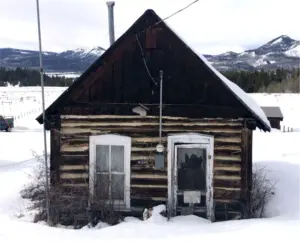
Judges Cabin — Statement of Significance
The Judges Cabin has been owned by the Schneider family, former residents of Craig, Colorado, since 1968. It is situated across Main Street from where the 1890s Courthouse was located when Hahns Peak was the county seat. Judge Charles F. Burnham owned the cabin from 1902-1907, then Judge Charles A. Morning from 1907-1915. Judge Morning moved his office to Steamboat following the 1912 election when voters approved changing the county seat to Steamboat Springs. Ruth Schneider has provided educational tours to school children; Dr.
Leo and Ruth Schneiders daughter, Deborah Sue Schneider-Pollok and her husband Mallory Pollok volunteered at the Hahns Peak Historical Society. Today the Schneider-Pollok Family owns three historic Hahns Peak homes. The cabin identification with persons who significantly contributed to the culture and development of Routt County make it an excellent choice for local historic designation under Criterion C. The Greek Revival style (popular 1830-1860 in the east) was rare elsewhere in Colorado yet excellent examples remain in mining towns. We see it today in Breckenridge, Cripple Creek, Hahns Peak and Leadville. The Wither Cabin and the Judges Cabin at Hahns Peak have the style of the gabled shape and pediment window trim reflecting classic Grecian design. The
Judges Cabin located on Main Street exemplifies the cultural, economic, and social heritage of a mining town in Routt County, Criterion D. Hahns Peak lookout had visitors from almost all 50 states and 32 foreign countries, summer 2025. Thank you for considering this property for historical designation. Preservation of cabins at Hahns Peak is important for North Routt, Colorado, our country and our international visitors.
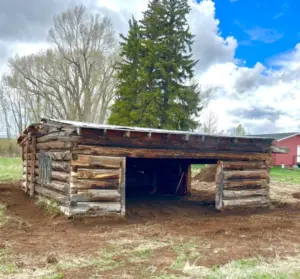
The Yampa Ranch Historic Barn — Statement of Significance
The Yampa Ranch historic log barn and granary meet Criterion D for their exemplification of the cultural, economic, social, or historic heritage of Routt County. The property was first claimed through a pre-emption entry in 1889 by James Sweeney and formally patented by the United States in 1894 under the Homestead Act of 1862. In 1906, the land was conveyed to John P. Phillips, an early settler in the Yampa Valley whose presence in the region dates to at least 1881.
Newspaper accounts preserved by the Tread of Pioneers Museum describe Phillips and other early settlers arriving in the Yampa Valley in the early 1880s, initially drawn by reports of available grass, water, and open land. These accounts recount early efforts to establish a foothold in the valley, including
the recovery of stolen livestock and a violent encounter near present-day Oak Creek that resulted in multiple deaths. Such events reflect the instability and risk present during the earliest period of settlement.
Despite these conditions, Phillips and others returned in 1882 with their families to establish permanent homesteads. Their efforts focused on constructing cabins and cutting native hay along the river, laying the groundwork for long-term agricultural use. This transition—from early, uncertain presence to permanent settlement and productive ranching—marks a critical phase in the development of the property and the Yampa Valley.
Historic appraisal records and site documentation confirm that the barn functioned as part of a larger agricultural complex that included multiple outbuildings such as hay barns, granaries, sheds, and stock structures typical of a self-sufficient ranching operation. While many of these associated structures have been lost over time, the surviving log barn and granary remain as a primary physical link to the property’s historic use.
A significant transition occurred in 1939, when a portion of the property was conveyed to Routt County for right-of-way associated with what is now Colorado Highway 131. This division separated what had historically been a unified homestead into distinct parcels. Lands beyond the corridor became associated with neighboring agricultural families, including the Brooks family, reflecting a broader pattern of subdivision while maintaining the agricultural character of the area.
Despite these changes, the land has remained in continuous agricultural use. The presence of long-established irrigation systems, supported by water rights tied to regional ditch networks dating to the late nineteenth and early twentieth centuries, underscores the property’s role within the historic irrigated agricultural landscape of the Yampa Valley.
The barn and granary remain part of an active agricultural setting and serves as a tangible connection to the original homestead. Their continued presence reflects both the durability of its construction and the continuity of land use across generations.
The barn and granary also meet Criterion F as an embodiment of the distinguishing characteristics of a historic architectural type, specifically a late nineteenth-century dovetail log barn and granary. They are surviving homestead-era agricultural structures that embodies the early settlement, ranching practices, and rural development of Routt County, Colorado.
Constructed in the 1880s near Yampa, Colorado, the barn represents a traditional form of log construction utilizing dovetail joinery, a method requiring skilled craftsmanship and precise fitting of interlocking corner notches. In addition to the joinery, the logs were hand-hewn, reflecting the labor-intensive building practices of the time. These materials were sourced locally, cut by hand, and transported to the site by horse-drawn wagon, often over considerable distances.
The resulting structures were necessarily modest in scale due to the limitations of available labor, transportation, and tools. The barn illustrates how early ranchers adapted construction methods to the realities of the landscape and available resources. Its relatively small size is characteristic of early log outbuildings, which were built for function using the materials that could reasonably be harvested and moved. Many barns of this type were constructed directly on the ground or on minimal foundations. Over time, exposure to moisture led to deterioration of the lower logs, contributing to structural failure.
Combined with their small size, these factors often made preservation impractical as ranch operations modernized. As a result, structures of this type—once common throughout the region—have largely disappeared.
The Yampa Ranch barn retains a high degree of integrity in its original materials and form, including the surviving dovetail corner joints and hand-hewn logs. Preservation and stabilization efforts have been undertaken to support the structure while maintaining its historic character. These efforts ensure that the defining architectural features remain visible and intact. The granary has recently been stabilized. Where the exterior siding is inside the framing, grain was stored, protected from rodents. Where the siding is outside the framing, it was a hay barn.
As surviving examples of a once-common but now increasingly rare building types, the barn and granary embody the craftsmanship, materials, and functional design associated with early ranching operations in Routt County and stands as an important representative of the region’s architectural heritage. The barn and the granary retain a high degree of integrity in location, design, materials, and workmanship, with original log construction, joinery, and granary siding clearly visible.
The remaining of the buildings on the property were built more recently and are not included in this application. They are non-contributing.
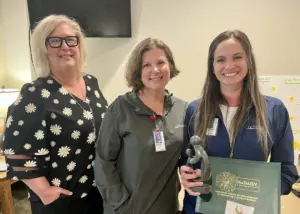
Registered nurse Samantha Stevenson at UCHealth Yampa Valley Medical Center has been honored with a DAISY Award. It’s an international recognition program for a nurse who has been extraordinary in their impact. Stevenson is a labor and delivery nurse who was nominated by Lyndsey Perry.

Young entrepreneurs in Routt County are participating in the 2026 4-H Youth Entrepreneurship Program, run by the Routt County Extension office. Nine students, ages eight to 18, have come up with things to create and sell. We spoke with a few of them who had never been on the radio before, until now.
The entrepreneurs will be at the Steamboat Springs Farmers Market a few times this summer, selling their products. The Ski Town USA Rotary Club also provided a $1,500 grant so the kids could get seed money for their projects.
More on the Story – Young entrepreneurs present their business ideas in 4-H Program




Total tallies are in for the free recycling weekend with D&D Metal Waste and Recycle on the west side of Steamboat Springs. Over 350 vehicles came through on Mother’s Day weekend with things to drop off. Here’s the list, courtesy of Emily Duksa at D&D.
- One car
- One golf cart
- 20 snowmobiles
- Two 30-yard containers of electronics like TVs, monitors and misc. computer parts
- Two 30-yard containers of refrigerators and appliances
- Three 30-yard containers of tires
- 2.5 totes of CPUs (Central Processing Units) and laptops
- 10 car batteries and miscellaneous batteries
- 100 gallons of oil
- 10 yards of loose uncompacted trash
- 1.5 30-yard container of green waste
More on the Story – Free Recycling Event at D&D Metal Recycle is a success

Financial Literacy Credit classes start Wednesday, May 13 in Oak Creek, hosted by United Way of the Yampa Valley. This is everything you need to know about credit cards, credit scores, and reports, and how they affect your financial health. A second class is May 27. Classes start at 6 p.m. at the South Routt Community Center in Oak Creek.
United Way website: Free, accessible workshops and Classes

Today is Scholarship and Awards for SoRoCo High School. It’s at 2 p.m.
Soroco Secondary Schools and Soroco Music present the 2026 Summer Celebration Concert. It’s at 6:30 p.m. Wednesday, May 13 also at Soroco High School.

Lifeguards are being hired for the Craig Swimming Complex this summer. Apply through the City of Craig website before May 22.
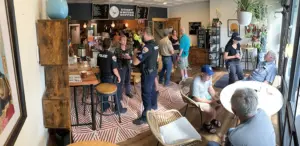
Wednesday morning is Coffee with Cops at Dusky Grouse Coffee on Mid Valley Drive. It’s from 8-10 a.m. All are invited for good conversation, good company and good coffee.

Check out what’s happening in the Yampa Valley on the Events Calendar on our website.

For the KRAI Time, Temp, and Weather Hotline, call 970-824-1918.